
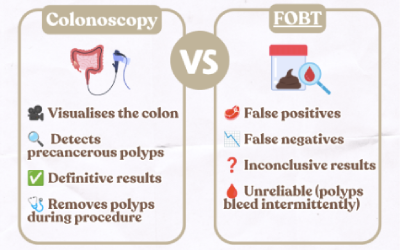
A faecal occult blood test (FOBT) is not a reliable way of confirming all is okay in your gut. The FOBT does not reliably tell you that there’s nothing wrong, nor does it reliably tell you that there is something wrong. This is why our practice has moved away from using this test for screening.
Dr. Maré Du Plessis explains why the faecal occult blood test is outdated and unreliable, and what makes colonoscopy the only truly reliable method of colorectal cancer screening.
Key takeaways:
- Don’t assume that no digestive symptoms = no colorectal cancer to find. Precancerous polyps are often completely asymptomatic.
- A faecal occult blood test has significant limitations, and can miss polyps.
- A colonoscopy allows us to directly visualise the colon, identifying and removing precancerous polyps during the procedure.
- Your risk of having polyps and colorectal cancer increases with age. Screening colonoscopy is recommended from the age of 45.
How does a faecal occult blood test work?
A faecal occult blood test evaluates a stool sample for hidden (‘occult’ refers to what cannot be seen with the naked eye) blood, which means there is bleeding somewhere in your digestive tract.
Why is the faecal occult blood test outdated?
In the past, if the faecal occult blood test results were positive, we understood that it might mean there’s a lesion in the colon. FOBT can indicate that there may be blood present, but it cannot show you whether there is a polyp, where it is, or what it looks like. To exclude colon cancer as the cause for this bleeding, we would then advise the patient to have a colonoscopy.
The FOBT is also affected by what you eat; If you have a good, hearty steak the day before or two days before, your faecal occult blood test can produce a false positive.
Can the test also produce a false negative?
Yes. A negative faecal occult blood test result does not mean there isn’t a polyp somewhere in the colon. Polyps can bleed intermittently; they don’t bleed all the time.
If the test is taken at a time when a polyp or polyps are not bleeding, the result can be negative even though the polyp is there.
So what does a colonoscopy tell you that a stool test can’t?
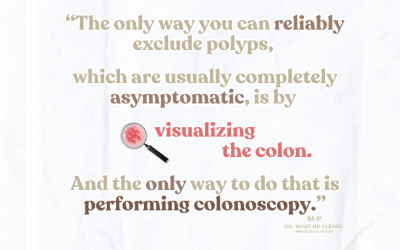
A colonoscopy allows us to actually see the inside of the colon. That’s the important difference.
Polyps are often asymptomatic, which is why screening colonoscopy can be life-saving. If there is a polyp, we can identify and remove it during the procedure. The tissue can then be sent for examination. You can’t do that with a stool test.
Colonoscopy is the most reliable tool to identify and remove polyps before cancer has a chance to develop.

When considering colonoscopy, what’s more important: Symptoms or risk factors?
The most important factor is your age, not digestive symptoms. As you get older, your risk of having polyps and colorectal cancer increases.
Screening colonoscopy is now recommended from the age of 45, because colorectal cancer has increasingly been diagnosed in younger patients. These cancers are often more aggressive, carrying a poorer prognosis when diagnosed at an advanced stage.
Where can I have a colonoscopy in Cape Town?
If you’ve been advised to have a colonoscopy, I perform colonoscopies at Mediclinic Milnerton in Cape Town. I have a dedicated colonoscopy suite at the practice, where the procedure can be performed in-rooms. My team aims to make the colonoscopy process as convenient and comfortable as possible for patients.
To schedule a colonoscopy with Dr. Maré Du Plessis at his Mediclinic Milnerton endoscopy suite, call 021 555 1877, email milnerton@drduplessis.com, or fill out our contact form and we’ll get in touch with you.